![]() |
![]() |
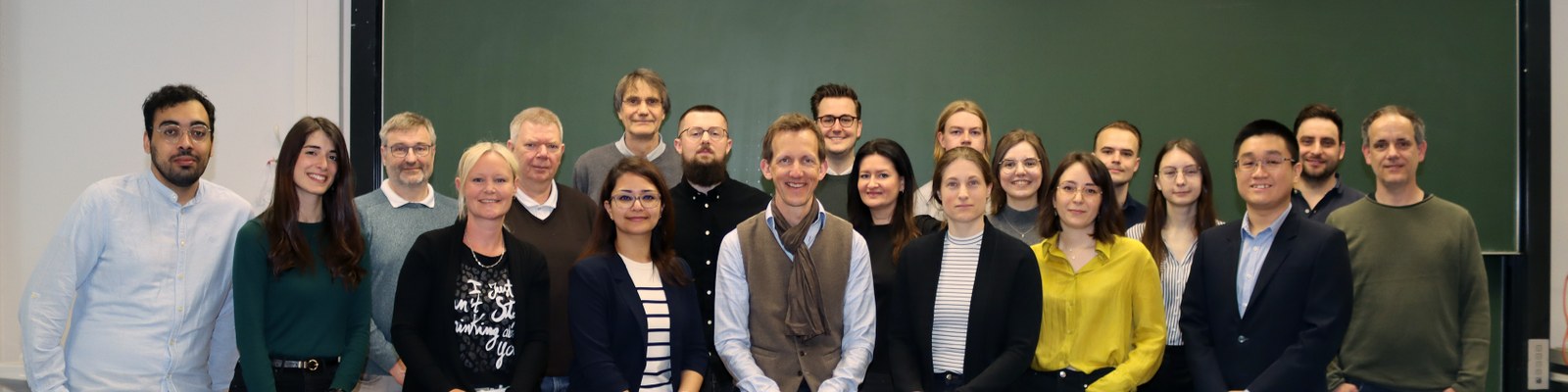
| The Kolb Lab is located at the Department of Pharmaceutical Chemistry at Philipps-Universität Marburg. | ![]() |
| The lab is deeply involved in COST Action CM1207 "GLISTEN: GPCR-Ligand Interactions, Structures, and Transmembrane Signalling: a European Research Network" | ![]() |
| We are also a member lab of SYNMIKRO. | ![]() |
| [en][de] |
Word cloud generated with Wordle from publication abstracts. Thanks to Xavier Deupi for the idea! |
Small molecules are frequently used both in Nature and therapeutically to modulate the activity of the protein they bind to. Yet, many aspects of small-molecule:protein interactions are surprisingly poorly understood. For instance, ligand polypharmacology, i.e. binding to multiple proteins, often comes as a surprise, although it is frequently precisely the reason for a drug's efficacy or its side effects. On the protein side, a point mutation in the binding site, although only a small change, can abolish drug binding, leading to resistance. Thus, it is highly relevant to develop a comprehensive understanding of small-molecule:protein interaction profiles in molecular detail and correlate these profiles with signaling and metabolic pathways. Our main tool is small molecule docking, but we also use chemoinformatic approaches and molecular dynamics. The research spans method development, basic research and applications. Currently the investigations deal with kinases and G-protein coupled receptors (GPCRs). |
| 16 | Limits of ligand selectivity from docking to models: In silico screening for A1 adenosine
receptor antagonists. PLOS ONE 2012, 7, e49910. [pdf] |
![]() |
||
| Jennifer Lehmann | [Intern] | |
| Florent Chevillard | [Graduate Student] | |
| Juan Carlos Mobarec | [Postdoc] | |
| Denis Schmidt | [Graduate Student] | |
| Peter Kolb | [Principal Investigator] | |
| Jakub Gunera | [Graduate Student] | |
We are developing and maintaining DAIM (Decomposition And Identification of Molecules), a program for fragment generation in the context of fragment-based docking and analysis of molecule libraries. For more information and potential other uses of DAIM see the manual or reference [4]. We are always happy about bug reports, but please consider reading this how-to by Simon Tatham before.
On September 7, 2009 DAIM 5.3 has been released. The update contains several improvements and allows more user choices with respect to the bonds that DAIM cuts. Essentially, it is now possible to override all of the default unbreakable bond definitions. To obtain it, please go to the download page.
Currently, there are no open funded positions. However, we always have projects for Master students and we are always open for applications from motivated individuals for other levels. Please send your application documents (CV [+ list of publications and the names of three referees, where appropriate]) to applications@kolblab.org.